

Broncolor Satos 1600 and 3200 Generator Why Pros Choose Quality Over Cost
Updated: Sep 7
A flash generator does not get attention when everything works. It becomes visible only when something falls short: a missed frame, a color shift, a slow recycle, an uneven skin tone, or a pack that cannot keep up with a demanding set.
That is why the Broncolor Satos matters. It is built for photographers who judge lighting gear by output quality, repeatability, control, and reliability under pressure. The Satos system sits in the category where cost is part of the conversation, but it is not the deciding factor. When the brief demands the best possible result, the light source must support that goal without compromise.
Available in 1600 J and 3200 J power options, the Broncolor Satos generator gives professional photographers a serious pack-based lighting platform for fashion, beauty, product, portrait, automotive, still life, and high-end commercial work.

The Satos is built for photographers who cannot accept almost right
Many flash systems can produce a bright burst of light. Fewer can deliver that burst with the consistency expected on a professional set.
The difference becomes clear in practical work. A beauty photographer may need subtle tonal control across dozens of near-identical frames. A product photographer may need repeatable highlights on glass, cosmetics, watches, jewelry, or polished metal. A commercial team may need a lighting setup that holds its behavior across a full shooting day.
This is where Broncolor has long earned its reputation. The brand is known for high-end pack-and-head systems that focus on precision rather than convenience alone. Satos continues that approach with a modern generator platform designed for controlled, demanding shoots.
The advantage is not just power. It is the quality of the power.
Professional flash performance depends on several things:
Stable color temperature
Consistent output from frame to frame
Fast and predictable recycling
Fine control over power
Reliable flash duration options
Compatibility with serious light shapers
A system that behaves the same in real production conditions
Cheaper systems may perform well in simple setups. They may even look close in casual testing. The difference appears when the shoot becomes less forgiving. When a client is watching, the set is complex, and every file needs to match, quality becomes easy to justify.
The 1600 and 3200 power options suit different kinds of work
Broncolor offers the Satos generator in two main power levels: Satos 1600 and Satos 3200. Both serve professional work, but they suit different production needs.
| Model | Best suited for | Why it matters |
|--------------|--------------------------------------------------------------|---------------------------------------------------------------------------------------------------|
| Satos 1600 | Beauty, portrait, fashion, product, editorial, controlled studio sets | Gives substantial power with excellent control, especially when the lighting setup does not require extreme output. |
| Satos 3200 | Large sets, automotive, room sets, high-output modifiers, deep depth of field, large format work | Provides more headroom for demanding setups, big light shapers, and situations where power reserves protect creative freedom. |
The Satos 1600 is the more compact answer for many studio photographers. It gives enough power for most controlled studio environments and allows refined control when working close to a subject. For portrait, beauty, tabletop, and fashion sets, it delivers the headroom needed without forcing the photographer into excessive output.
The Satos 3200 is the choice when the production scale grows. Large softboxes, deep umbrellas, para reflectors, scrims, diffusion frames, and long throw distances all consume power. So do small apertures, large sets, and subjects that require broad, even coverage. In those cases, extra watt-seconds are not a luxury. They are working space.
The real benefit of choosing between 1600 and 3200 is not simply having “more” or “less” power. It is matching the generator to the type of control required. A photographer who often works in beauty may prefer the balance of the 1600. A team shooting cars, furniture, room sets, or large campaigns may choose the 3200 for its reserve capacity.
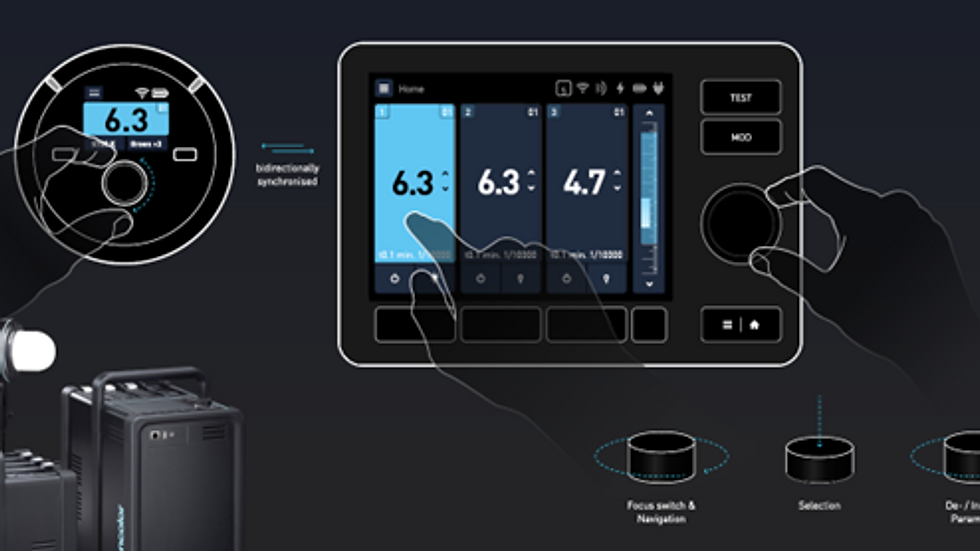
Why Satos stands above many other generator systems
The professional lighting market has strong options from several brands. Many of them can handle general studio work well. The Broncolor Satos generator, though, competes at the level where the details matter more than the spec sheet headline.
A lower-cost pack may claim high output. A portable system may promise convenience. A monolight system may be simple to set up. Those things have value. But Satos is built for photographers who prioritize controlled performance across demanding work.
It delivers refined light control
Professional lighting is rarely about blasting a subject with maximum output. It is about shaping light with intent.
With a generator system like Satos, photographers can work with separate flash heads, large light modifiers, boom-mounted lights, overhead sources, and complex multi-light arrangements. The pack stays accessible while the heads can be placed exactly where the set demands.
That matters for:
Overhead beauty lighting
Gridded accents and background lights
Large diffused sources
Product highlights that need millimeter-level adjustment
Sets where heat, weight, and cable management affect the workflow
The separation of generator and flash head remains one of the major advantages of a high-end pack system. It keeps the active light head leaner and gives the photographer more flexibility in placement.
It rewards careful photographers
Satos is not aimed at photographers who only need quick snapshots or simple one-light setups. It rewards photographers who notice small changes in contrast, specular highlights, skin texture, fabric detail, and color.
That is a key reason cost should sit behind results in the buying decision. If a generator produces cleaner files, reduces retouching time, keeps a set consistent, and protects the quality of a campaign, its value goes beyond the purchase price.
Professionals know that lighting quality affects everything after capture. It affects file flexibility, color grading, print quality, client approval, and the time spent correcting avoidable problems.
It is made for system-level performance
A flash generator should not be judged in isolation. It belongs to a system.
Broncolor’s strength lies in the way its packs, heads, reflectors, modifiers, and accessories work together. The Satos generator becomes more useful when paired with the right flash heads and light shapers. That is where the system’s quality becomes visible.
A premium generator with premium modifiers gives photographers control over both energy and shape. This is where many lower-cost setups struggle. They may offer enough raw power, but the broader ecosystem may not give the same level of precision, durability, or refinement.
Cost is secondary when the work demands the best result
There is no need to pretend that a Broncolor Satos system is the cheapest path into studio flash. It is not. That is also not the point.
For working photographers, cost is only one part of value. The more important question is whether the equipment protects the quality of the work.
A serious campaign can involve a creative director, stylist, makeup artist, art buyer, producer, assistants, talent, set build, location fee, and post-production budget. In that context, the lighting system cannot be the weak link. Saving money on the generator makes little sense if it introduces uncertainty into the files.
The best photographers often pay for equipment that disappears during the shoot. They want tools that behave predictably, respond accurately, and stay stable over long sessions.
That is the strongest argument for Satos. It is not merely a powerful generator. It is a confidence tool.
When the image must be right, the cost of better lighting is often smaller than the cost of fixing avoidable problems later.
This is especially true for photographers in competitive markets, including commercial studios in the UAE, where clients increasingly expect international-level production quality. A premium lighting system helps support that standard, whether the work is for luxury products, fashion editorials, e-commerce campaigns, hospitality brands, or high-end portraits.

Compatible flash heads for the Broncolor Satos generator
The Satos system is designed to work with Broncolor flash heads suited to professional pack-based shooting. Compatibility can vary by connection type, cable, region, and firmware or accessory configuration, so final pairing should always be confirmed with an authorized Broncolor dealer before purchase.
Commonly associated compatible or system-relevant flash heads include:
Broncolor Pulso L 1600
A modern flash head designed to pair naturally with the Satos 1600 power class.
Broncolor Pulso L 3200
The higher-capacity Pulso L option for photographers using the Satos 3200 or working with demanding output needs.
Broncolor Pulso G
A widely recognized Broncolor lamp head line used in many professional studio systems.
Broncolor Unilite
A compact, general-purpose flash head often used in studio setups where flexible placement matters.
Broncolor Picolite
A small special-purpose head used for precise lighting tasks, often with close-up, product, and accent work.
Broncolor Ringflash C
A ringflash option for fashion, beauty, portrait, and specialized direct-light effects.
Broncolor Litestick
A narrow light source used for product, still life, edge effects, and controlled highlights.
Broncolor Lightbar
A linear light source useful for reflections, gradients, product edges, and long highlights.
This list shows why Satos is more than a generator. It gives access to a serious lighting ecosystem. The right head choice changes how the system behaves on set.
For example, Pulso L heads make sense for photographers who want current-generation pack-and-head performance. Picolite and Litestick options suit still life specialists who need precision. Ringflash C gives a distinct direct-light look that still appears in fashion and beauty work. Lightbar-style tools help create elegant reflections that would be difficult to produce with ordinary heads.
Where the Satos 1600 makes the most sense
The Satos 1600 is a strong fit for photographers who need premium quality but do not always need maximum power.
It suits:
Beauty and cosmetics
Portraiture
Fashion editorials
Catalogue and e-commerce sets
Tabletop product photography
Food photography
Small to medium commercial sets
In these environments, the key requirement is often control rather than brute force. The photographer may work with modifiers close to the subject, lower to mid-power ranges, and carefully shaped sources. The 1600 provides enough headroom while preserving the finesse expected from a premium generator.
It is also easier to justify for studios that want Broncolor quality as their daily system. For many photographers, the 1600 is the practical workhorse.
Where the Satos 3200 becomes the better choice
The Satos 3200 comes into its own when output reserves matter.
It suits:
Automotive photography
Furniture and interiors
Large product sets
Full-length fashion with large modifiers
Sets using heavy diffusion
High f-stop still life work
Larger studio spaces
Power reserves reduce compromise. A photographer can use larger modifiers, place lights farther away, shoot at smaller apertures, or cover more area without pushing the system to its limit.
That headroom can also improve pace on set. When a generator is not constantly working near its ceiling, the shooting rhythm often feels more comfortable. For complex commercial productions, that matters.

The real verdict is about confidence
The Broncolor Satos 1600 and 3200 are not casual lighting purchases. They are professional tools for photographers who see lighting as part of image quality, not just exposure.
The Satos 1600 is the refined choice for many studios that need premium control, dependable output, and everyday flexibility. The Satos 3200 is the stronger option for photographers who regularly work at scale or need more power reserve for complex sets.
Compared with many other brands, Satos stands out because it focuses on what demanding photographers actually need: precision, repeatability, system depth, and long-session reliability. Those qualities are hard to appreciate on paper, but easy to recognize on set.
Cost matters in business. Results matter more when the image carries the reputation of the photographer and the client. For professionals who want the cleanest path to consistent, high-end lighting, the Broncolor Satos system makes a clear case for choosing quality first.


Comments